
For years, we’ve been told to watch the same indicators: jobs, retail sales, and housing. If employment is strong, the economy must be strong.
That assumption no longer holds.
The American economy hasn’t stopped being consumer-driven—it has quietly changed what “consumer” means. Today’s growth is powered less by wage earners buying goods and more by asset holders spending accumulated wealth. Travel, entertainment, healthcare, and digital services now dominate. Much of that spending is coming from Baby Boomers, who control a large share of the nation’s wealth.
This has created a split economy.
On one side are households with assets—stocks, real estate, retirement accounts—spending freely. On the other hand, wage earners face higher costs, limited savings, and little room to maneuver. The headline numbers look fine. The reality underneath is far less balanced.
At the corporate level, the search for growth has landed squarely on artificial intelligence. Companies are investing billions into infrastructure—data centers, chips, and software—hoping to unlock future efficiency. Much of that money is flowing to a handful of dominant players like NVIDIA, Microsoft, and Amazon.
This isn’t the dot-com era. These are real companies with real earnings. But the strategy is familiar: spend heavily today in expectation of gains tomorrow. If those gains take longer than expected—or fail to materialize—balance sheets will feel the strain.
Meanwhile, the stock market continues to climb, driven less by fundamentals and more by a simple problem: there are few alternatives. Bonds have struggled, cash yields won’t last, and retirement money keeps flowing in. Capital needs a home, and equities—particularly those tied to AI—are where it’s going.
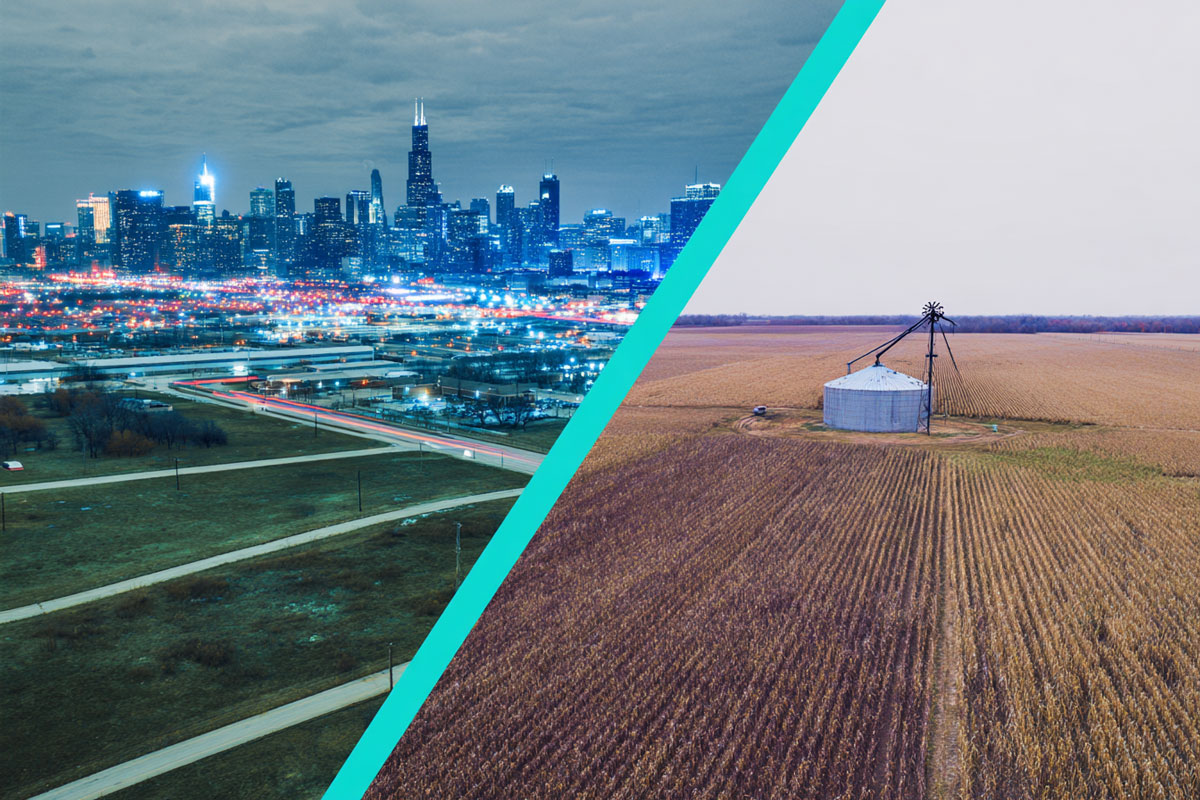
Now contrast that with another part of the country.
Agriculture is facing a very different reality. Farmers are producing more than ever, yet earning less for what they grow. High yields are pushing prices down, while input costs—fertilizer, fuel, seed—remain high. Add rising interest rates and heavy borrowing, and margins disappear quickly.
The old idea that you can “grow your way to prosperity” no longer works. In agriculture, producing more often means earning less. It’s one of the few industries where efficiency can be punished.
To keep the system afloat, excess production is exported or supported by government programs. Corn is turned into ethanol not purely because of demand, but because it helps stabilize prices. These are stopgap measures, not solutions.
The loss of major export markets, especially China, only tightens the vise.
What we are seeing is not a single economic cycle, but a divergence.
Technology-driven and wealth-supported regions continue to expand. Places like Sedona—buoyed by tourism, second homes, and discretionary spending—benefit from this momentum. At the same time, commodity-dependent regions are under increasing pressure, facing lower prices, higher costs, and mounting debt.
We’ve seen this before. In the 1980s, manufacturing went through a similar shift. Productivity improved, but many smaller players disappeared, leaving entire regions behind.
Agriculture may now be entering that same phase.
The next downturn, if it comes, won’t look like 2008. It won’t hit everywhere at once. It will be uneven—strong in some regions, deeply painful in others.
In other words, the next recession may not feel like a recession at all—unless you happen to be in the wrong place








Leave A Comment